Air fresheners only add fragrance on top. Here is how to actually remove pet odors at the source.
If you have a dog or a cat, you have probably gone nose-blind to the smell of your own home. It happens gradually. The odor builds up slowly enough that you stop noticing it. Then a friend visits and you see it on their face the moment they walk in the door.
The instinct is to reach for an air freshener or a scented candle. That helps for about 20 minutes. Then the underlying smell comes back, now competing with a layer of artificial fragrance that somehow makes the whole thing worse. The problem is not the air. The problem is the surfaces.
Where pet odors actually live
Pet odors come from organic compounds, mainly dander, saliva, urine, and the natural oils in an animal's coat. These compounds do not float in the air indefinitely. They land on surfaces and absorb into porous materials: carpet fibers, upholstery fabric, wood flooring, drywall, and even the grout between your floor tiles.
This is why air fresheners do not work. They address the air, not the source. The source is your couch, your carpet, your dog's favorite corner of the bedroom floor, and the baseboards your cat rubs against every morning.
In South Florida, the humidity makes it worse. Humidity causes organic compounds to off-gas more readily, which is the scientific explanation for why your house smells more like your dog on a rainy day than on a dry one.
The enzyme cleaner difference
The most important thing to understand about pet odor removal is the role of enzyme cleaners. Regular cleaners, including most disinfectants, clean the surface but do not break down the organic compounds that cause the smell. Enzyme cleaners contain biological enzymes that digest those compounds, converting them into carbon dioxide and water.
For urine accidents specifically, enzyme cleaners are not optional, they are the only thing that actually works. Urine contains uric acid crystals that bond to surfaces and are not water-soluble. They cannot be removed by scrubbing or by conventional cleaners. Enzyme cleaners break the crystals down at a molecular level. Products like Nature's Miracle, Rocco & Roxie, and Angry Orange are well-reviewed and widely available.
The key to using enzyme cleaners correctly is to saturate the affected area, not just spray the surface. Urine soaks into carpet padding and subfloor. If you only treat the carpet fibers, the smell returns when the area gets humid. Apply enough product to reach the same depth the urine penetrated, cover with a damp cloth so it does not dry too quickly, and let it sit for at least 10 minutes, longer for old stains.
Carpets and upholstery, the biggest reservoirs
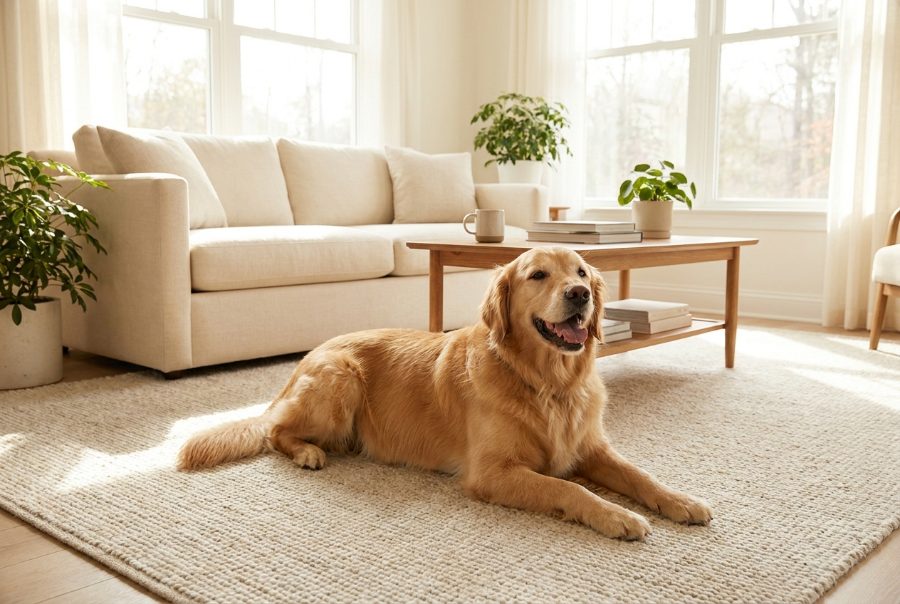
If you have a dog and wall-to-wall carpet, the carpet is holding a significant amount of dander, oils, and possibly urine residue even if you have never had an obvious accident. Regular vacuuming removes surface debris but does not address what is embedded in the fibers.
Baking soda is genuinely useful here. Sprinkle it generously over the carpet, work it in with a brush, leave it for at least 30 minutes (overnight is better), and vacuum thoroughly. Baking soda is alkaline and neutralizes the acidic compounds that cause odor. It will not remove stains, but it will noticeably reduce ambient odor.
For upholstery, the same principle applies. Sprinkle baking soda, let it sit, vacuum it off. For fabric sofas and chairs that have absorbed years of pet odor, a professional upholstery cleaning with a steam cleaner and enzyme treatment is the most effective option, more effective than anything you can do with a spray bottle.
The surfaces people forget
Baseboards are one of the most overlooked sources of pet odor. Dogs and cats rub against them constantly, depositing oils and dander at floor level. Wiping baseboards with a damp cloth and a mild all-purpose cleaner once a month makes a real difference.
Walls, particularly in corners and at pet height, absorb oils and dander over time. A wipe-down with a diluted vinegar solution or a mild all-purpose cleaner handles this.
Washing your pet's bedding weekly, in hot water, removes the concentrated source of dander and oils that contributes most to the ambient smell. If your pet sleeps on your bed or couch, washing those covers weekly matters too.
Air quality, the last piece
Once you have addressed the surfaces, air filtration makes a meaningful difference. A HEPA air purifier in the main living area and bedroom captures airborne dander and particles that contribute to both odor and allergy symptoms. In a South Florida home where windows are often closed for AC, air circulation is limited and particles accumulate faster.
Replace your AC filter every 60 days if you have pets, more often than the standard 90-day recommendation. Pet dander clogs filters quickly, and a clogged filter recirculates particles rather than capturing them.
The combination of enzyme cleaning for accidents and urine residue, regular baking soda treatment for carpets and upholstery, consistent surface cleaning, and good air filtration is what actually eliminates pet odor rather than just managing it. It takes more effort than lighting a candle, but it works.